
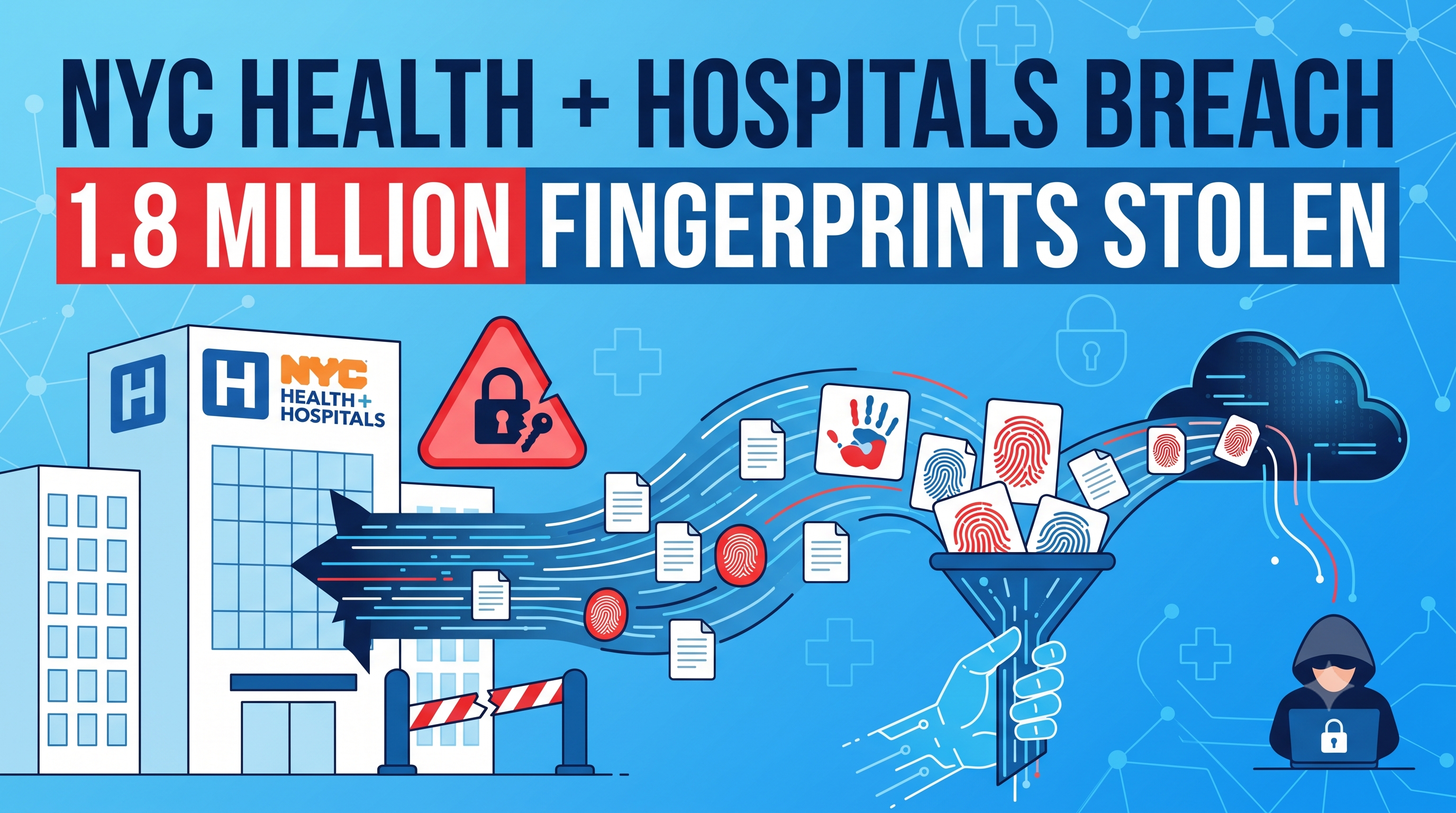
NYC Health and Hospitals Breach Exposes 1.8 Million – Fingerprints Stolen
A data breach at New York City Health + Hospitals (NYCHH) — the largest public healthcare system in the United States — has exposed the personal, medical, financial, and biometric data of at least 1.8 million people. Hackers were inside the network for months before the breach was discovered. They didn’t just steal names and addresses. They took fingerprint scans.
That’s the detail that separates this breach from every other healthcare incident this year. Fingerprints can’t be cancelled like a credit card. They can’t be rotated like a password. Once biometric data is out, it’s out — permanently.
“This is one of the most sensitive categories of data that can be stolen. Unlike a Social Security number or credit card, you cannot issue a new fingerprint.”
What Happened at NYC Health + Hospitals
NYC Health + Hospitals operates 11 acute-care facilities, dozens of clinics, and a network that serves over 1 million New Yorkers annually. According to disclosures made public on May 18, 2026, attackers compromised the organisation’s internal network. They gained access to a treasure trove of sensitive data over what investigators describe as a months-long intrusion.
The stolen data includes personal identification information, medical records, financial information, government IDs, and, critically, biometric fingerprint scans used for patient and employee identity verification. The total number of people impacted — 1.8 million — makes this one of the largest healthcare data breaches disclosed in 2026.
Why the Biometric Data Is the Real Nightmare
Healthcare organisations collect and store biometric data for legitimate reasons: patient identification, access control for secure areas, and digital health record authentication. It’s considered a security best practice. But when that biometric data is stolen in a breach, it creates a category of harm that traditional identity theft protections cannot address.
Here’s what makes fingerprints uniquely dangerous in a breach context:
- You can’t change them. A compromised password can be reset. A stolen credit card can be cancelled. Your fingerprints are with you for life — and now, with 1.8 million records in the hands of threat actors, there’s no recall mechanism.
- They enable high-confidence identity fraud. Biometrics are increasingly used by banks, government agencies, and financial institutions as a “final proof” of identity. A criminal armed with your name, SSN, medical history, and fingerprint could pass biometric verification for years to come.
- The attack surface is permanent. Unlike a data breach, where you can “move on” after changing credentials, affected individuals face lifelong risk every time their biometrics are used for authentication.
Healthcare: The Industry Threat Actors Can’t Stop Targeting
The NYCHH breach is not an anomaly — it’s the continuation of a relentless trend. Healthcare has been the most expensive industry for data breaches for years, with the average breach costing over $10 million in the United States. The sector combines three characteristics that make it irresistible to attackers:
- High-value data. Medical records sell for significantly more than financial data on dark web markets because they contain everything needed for full identity fraud — demographics, insurance, medical history, and biometrics.
- Legacy infrastructure. Many hospitals run systems that are decades old. Patching a CT scanner running Windows XP is not straightforward, leaving entire networks vulnerable to known exploits.
- Lives-on-the-line constraints. Unlike a bank, a hospital can’t simply take its systems offline during a cyber incident. This gives attackers more time to establish persistence and exfiltrate data before being detected.
What You Need to Do If You Were Affected
If you received a breach notification from NYC Health + Hospitals, or if you are a patient in the NYCHH system, take these steps immediately:
- Accept the credit monitoring offer. NYCHH is required to offer free credit monitoring to affected individuals. Take it — it’s a baseline protection layer, even if it won’t fully cover biometric fraud.
- Place a fraud alert. Contact one of the three major credit bureaus (Equifax, Experian, or TransUnion) and place a fraud alert. This forces creditors to verify your identity before opening new accounts in your name.
- File an IRS Identity Protection PIN. Since SSNs were likely compromised, request an IP PIN from the IRS — this prevents criminals from filing fraudulent tax returns in your name.
- Monitor medical records closely. Review Explanation of Benefits statements carefully. Watch for unfamiliar diagnoses, prescriptions, or procedures — these are signs someone may be using your identity for medical fraud.
- Be sceptical of “biometric” phishing. Criminals who have your fingerprint data may attempt highly targeted spear-phishing attacks using the medical context of your records.
The Bigger Picture: We Need to Rethink Biometric Security
The NYCHH breach exposes a fundamental contradiction in how the industry approaches biometric authentication. Biometrics are marketed as the most secure authentication method — because you can’t guess or phish a fingerprint. But they’re also the most permanent form of compromise — because you can’t revoke a stolen fingerprint.
Security researchers have long argued that biometrics should be used only as one factor in multi-factor authentication, not as a standalone proof of identity. The healthcare industry has been slow to adopt this approach. This breach is a wake-up call: storing biometric templates in centralised databases creates single points of failure with catastrophic consequences.
The question regulators will be asking in the coming weeks is whether NYCHH met its obligations under HIPAA and New York’s SHIELD Act for protecting sensitive biometric data. For the 1.8 million affected individuals, that regulatory conversation is cold comfort. Their biometric data is already in the wrong hands.
Stay ahead of the next breach. Follow CyberSlide for daily cybersecurity news, threat analysis, and actionable security intelligence.